Fire-Resistant vs Burglary-Only Security Safe: Which to Choose?
Fire-Resistant Security Safe vs Burglary-Only Security Safe: Which Should You Choose?
Choose the fire-resistant security safe when the loss you cannot recover from is heat damage to documents, contracts or media. Choose the burglary-only security safe when the loss you cannot recover from is forced entry to cash, jewelry or firearms. When both losses are material, no single-function safe delivers both claims — you either specify a composite model or split the risk across two units.
This guide is written for distributors, importers, brand owners and procurement teams who are past the discovery stage and now have to commit to one primary protection claim per SKU. It compares the two categories on application fit, certification logic, weight and installation, and what end customers actually expect — so the decision can be made from a risk scenario rather than from a product label.
The Two Claims Are Not Two Grades of the Same Product
A fire-resistant security safe and a burglary-only security safe are built around different failure events. One is designed to slow heat transfer; the other is designed to slow physical attack. That is why a well-made model in one category can be weaker than a budget model in the other category without either product being defective.
A fire-resistant safe uses a steel body combined with fire insulation — commonly a double-layer insulation build — so the internal temperature stays within a range that paper documents and media can survive for a stated period. The claim is a time rating: how long the interior stays protected during a fire.
A burglary-only safe relies on steel plate thickness, door construction, locking bolts and anti-pry geometry to resist prying, sawing and drilling. The claim is resistance to forced entry. It has no fire insulation layer, and therefore no fire claim.
This distinction is stated directly in safe-manufacturing guidance: fire-resistant safes adopt double-layer fire insulation to protect paper documents against high temperature, while standard burglary-only safes provide steel-plate protection without fire resistance. Buyers who need both protections are directed to combined fire-and-burglary-resistant models, because single-function safes cannot deliver both.
What each claim actually protects
- Fire-resistant claim: contracts, invoices, property deeds, personnel files, paper archives, backup disks and other media whose value collapses once heat damage occurs.
- Burglary-only claim: cash, jewelry, precious metals, seals, handguns and ammunition — items that survive a fire only if they are removed from the building, but disappear immediately if someone gets inside the box.
The consequence for a buyer is simple. If you buy a burglary-only safe and a fire occurs, the door may still be locked and the contents still destroyed. If you buy a fire-resistant safe and a break-in occurs, the insulation may be intact and the door forced. Neither product is failing its specification; the specification was simply written for the wrong event.
Why Buyers Are Forced to Pick One Claim
Most buyers do not choose between these categories by preference. They are pushed into a single claim by certification scope, shelf space, price points and what the destination market will accept on a label.
In North America, demand for security safes is driven by firearm storage regulation, wildfire risk, insurance requirements and the growth of online retail. Gun safes remain a large growth segment as more states tighten firearm safe-storage rules, and certified fireproof safes gain demand as wildfire concerns push homeowners to protect documents, jewelry and digital media. Certified models are also treated as insurance-relevant and can support retail price premiums, while mainstream retail channels and marketplaces increasingly require verifiable NRTL certification such as ETL.
That market context produces a practical constraint. A retail listing, a catalogue page or a distributor price list usually carries one headline claim per SKU, because a single-function product only supports one. The buyer's real task is therefore not to find the strongest safe, but to decide which claim the SKU must carry for the customers it will serve.
The Four Trade-Offs That Decide the Purchase
1. Application fit
Start from the contents, not the product name. Fire-resistant models are typically specified for offices, archives and retail premises holding contracts, invoices and hard-disk data. Burglary-resistant models are typically specified for jewelry stores, supermarkets, households storing cash and valuables, and firearm storage. If a project holds both document-type and cash-type assets, the correct answer is a composite model or two units — not a compromise on one unit.
2. Certification logic
Certification follows the claim, and the scope wording matters more than the logo. TIGERKING SECURITY SAFE (Ningbo Tigerking Safe Co., Ltd., founded in 2000 in the Daxie Development Zone, Ningbo, Zhejiang, China) illustrates how the two claim types are documented separately:
- Fire claim: ETL Verified certificate 211130001SHF, issued by Intertek Testing Services NA, Inc., covers a 60-minute fire resistance electronic safe and references UL 72 (2015) (R2020).
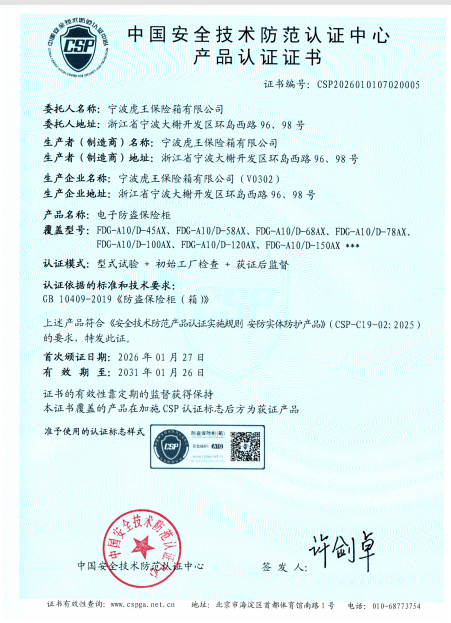
- Burglary claim: CSP certificate CSP2026010107020005, Security Grade A10, is issued by the China Safety Technology & Security Protection Certification Center against GB 10409-2019 for an electronic burglary-resistant safe.
- Neither claim: CE EMC certificate SHEM240300108001HSC and UKCA EMC certificate SHEM240300108101HSC, both issued by SGS-CSTC Standards Technical Services Co., Ltd., cover electromagnetic compatibility only.
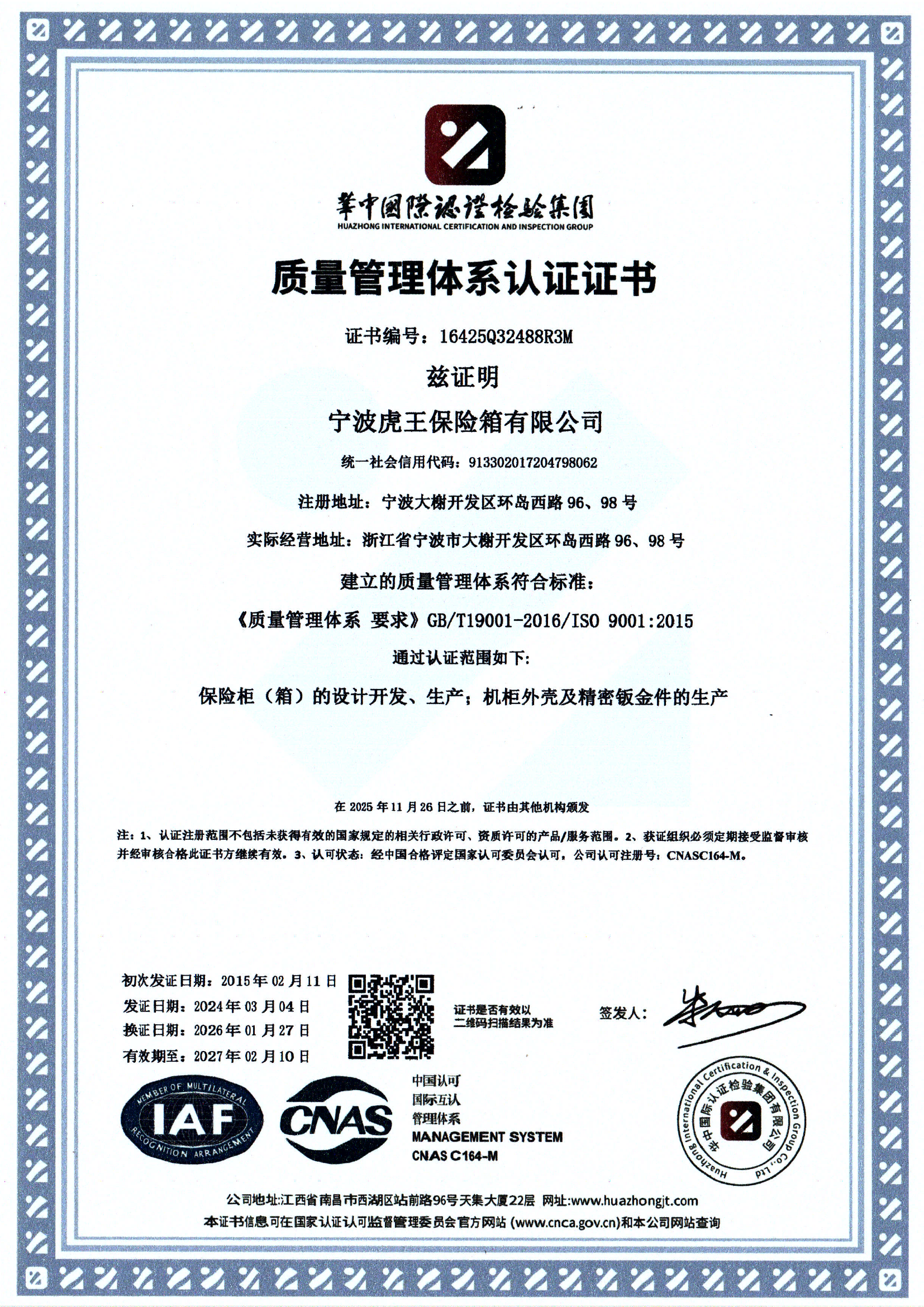
System-level certificates sit above both: ISO 9001 certificate 16425Q32488R3M and ISO 14001 certificate 00224E34629R1M confirm the management system, not the protection performance of a specific model. Buyers comparing suppliers should check three things — certificate scope, issuing body, and validity — before accepting a claim in a quotation.
3. Weight, floor loading and anchoring
Fire-resistant construction adds an insulation layer on top of the steel body, so the same external footprint generally weighs more than a burglary-only equivalent. That affects two things in a project: floor loading in upper-floor offices and residential buildings, and handling during delivery and installation.
For burglary-only models, weight is not the security mechanism by itself. Installation is. High-security projects require reinforced floor or wall mounting to prevent whole-cabinet removal, and anchoring with expansion bolts is the standard recommendation. A light, well-anchored burglary-resistant safe resists attack better than a heavy unit standing free in a corner.
4. Customer expectation and channel requirements
End customers evaluate the two categories with different questions. In the fire category, buyers ask for the rating period and the certificate number, because the certification is the selling point. In the burglary category, buyers ask about steel thickness, door construction, bolt count and lock type, because those are the comparison points they can see.
Channel requirements follow the same logic. Supermarket and retail programmes typically require compliant labelling, local-language manuals and retail-grade packaging alongside the claim itself, and OEM private-label orders add a further constraint: some certifications do not permit re-issue under a customer's brand name, so the certificate scope must be confirmed before artwork is approved.
Comparison Table
| Decision factor | Fire-resistant security safe | Burglary-only security safe |
|---|---|---|
| Primary protection claim | Limits internal temperature rise during a fire for a stated period | Resists forced entry by prying, sawing and drilling |
| Construction logic | Steel body plus double-layer fire insulation | Steel plate body with anti-pry door geometry, locking bolts and drill resistance |
| Standards commonly referenced | UL 72 fire endurance testing; ETL Verified scope on the 60-minute model | GB 10409-2019 under CSP Grade A10; EN 1143 and UL 687 are also cited in this category |
| Typical contents | Contracts, invoices, deeds, archives, backup disks and media | Cash, jewelry, precious metals, seals, firearms and ammunition |
| Typical settings | Offices, archives, retail back offices | Jewelry stores, supermarkets, homes, firearm storage |
| Weight and installation | Insulation layer adds mass; check floor loading before specifying large units | Steel-led construction; anchoring with expansion bolts is still required to prevent removal |
| What the buyer checks first | Rating period, certificate number, tested model | Steel specification, door construction, lock and bolt system |
| Customer expectation | Certified fire rating treated as a key selling point; can support insurance conversations and retail price premiums | Burglary grade and lock quality treated as the comparison basis |
| Relative cost position | Generally higher, because insulation and a double-layer build are added | Lower for a pure anti-theft requirement |
| Best-fit risk scenario | Fire is the dominant, non-recoverable loss | Theft or insider removal is the dominant loss |
Step-by-Step: Choosing One Primary Claim in Six Steps
The sequence below keeps the decision anchored to the risk scenario instead of to catalogue language. Each step produces an output that can be written into a specification or a purchase order.
Step 1 — List the contents that cannot be replaced
Separate assets into two columns: those destroyed by heat, and those removed by a person. Documents, deeds and media belong in the first column. Cash, jewelry, metals and firearms belong in the second. The column with the higher replacement cost sets the primary claim.
Step 2 — Name the dominant loss event for the site
Offices and archives in multi-tenant buildings usually carry a higher relative fire exposure. Ground-floor retail with cash on the premises, jewelry counters and residential firearm storage usually carry a higher relative forced-entry exposure. This is a judgement about the site, not about the product.
Step 3 — Match the claim to the destination market's certification requirement
Confirm which certificate the channel accepts, then confirm that the certificate scope covers the claim. For a fire claim, ask for the fire test reference and the tested model number. For a burglary claim, ask for the grade and the standard it was tested against. For electronics sold into the EU or UK, EMC compliance is an additional requirement, not a substitute for either claim.
Step 4 — Check installation before ordering
Confirm the mounting surface, the anchor method and, for heavier fire-rated units, the floor loading. Specify anchoring for burglary-only units as standard practice; an unanchored cabinet can be removed as a whole, which defeats the protection claim entirely.
Step 5 — Validate with a sample
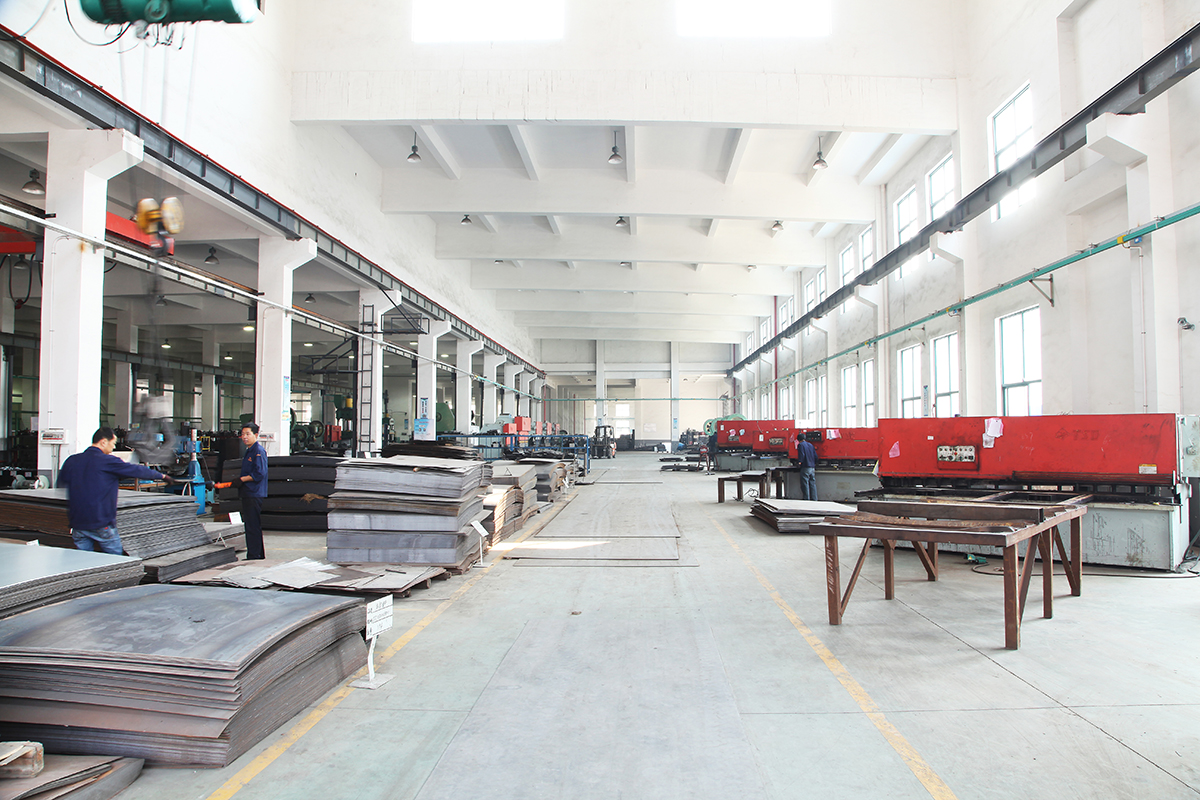
Sample approval is the point where the claim becomes verifiable. A full sample check covers physical dimensions and steel plate thickness measured with calipers; appearance and coating; all unlocking methods including keypad, fingerprint and mechanical override; door gap uniformity and bolt operation; certification marks and model numbers against the agreed standard; packaging and accessories; and, where a fire or burglary claim is promised, the agreed functional test against the relevant standard.
Step 6 — Lock the claim into the contract
Write the claim, the certificate reference and the acceptance criteria into the purchase order. Add change control: any structural or component substitution must be notified in writing and re-tested before shipment, and cost-reduction material substitutions without approval are not acceptable. Confirm the warranty and spare-parts arrangement at the same time — a standard warranty covering manufacturing defects for at least one to two years is a common baseline, but the practical differentiator is whether replacement parts and technical support are available after the sale.
Use Cases: Which Claim Fits Which Setting
Home projects
Households usually mix both risk types: passports and deeds alongside jewelry and cash. Where the primary requirement is daily anti-theft protection for jewelry, documents and cash, a burglary-resistant home unit is the conventional choice. Where documents dominate, the fire claim should lead. TIGERKING's home range includes models 78AX, 45RL, 78RL, 76RHV, 63XZ, 45XHZ, 60ZHZ, 43JJH, 58JJH and 45BH.
Office and commercial projects
Offices storing company seals, financial vouchers, contracts and confidential documents are a fire-led scenario, because the loss event destroys the record itself. Office models in the TIGERKING range include KS48, KEY27 and LSDW-25MD; the commercial range includes DP450-LE, DF2014-MA, DF3020-MA, DF3020-DKA, DF4020-DDA, DF4020-MMA, DR2014-DA and DR2014-MA. A distributor supplying office projects reported around 10,000 units per year into offices, hotels and properties for seals, vouchers, contracts and confidential documents, with a commercial structure designed for high-frequency use.
Jewelry and high-value retail
Jewelry stores sit firmly in the burglary-led category: heavy-duty body, anti-drill and anti-pry design, and a high-strength lock cylinder. TIGERKING's jewelry range covers 120FR, 150JGH and FPSC150, and a supplier serving jewelry and luxury retail reported around 10,000 units per year for gold, diamonds and precious metals.
Firearm storage
Firearm storage is the clearest case where a single claim is often not enough. Local regulations drive the security requirement, while the contents are also vulnerable to heat and structural collapse. Fire-resistant gun safes combine thicker steel with fire insulation, and the practical specification question is whether the model carries both a steel specification and a verified fire rating. TIGERKING's gun range includes G1300K3, G1300K5, G1450K3, G1450K5, PB20, PB4-F, GFP5924, GFP5928, GFP5930 and GFP7240; a North American importer reported around 20,000 units per year of UL-certified fire-resistant gun safes for compliant household and gun-store storage.
Ranked Recommendation: Three Protection Setups, Best Fit First
The ranking below is ordered by how often each setup is the correct single answer for a home or office project, not by protection strength. A composite safe covers more risks than either single-function type, but it is not the right default for every budget or every site.
Rank 1 — Fire-resistant as the primary claim
Correct answer for offices, archives and back-office retail where documents, contracts and media are the irreplaceable assets. Specify a rated model and quote the certificate reference in the offer. TIGERKING's fireproof range covers FPSD66, FPS60DF, FPSA60, FPSB60 and FPSE60SP, with ETL Verified certificate 211130001SHF supporting the 60-minute fire claim.
Rank 2 — Burglary-resistant as the primary claim
Correct answer where cash, jewelry or firearms are the main exposure and the site has meaningful forced-entry risk. TIGERKING's burglary-resistant range covers the smart I-JS and smart I-GS models, certified to CSP Security Grade A10 under GB 10409-2019. Pair the unit with anchoring as standard.
Rank 3 — Composite or layered protection
Correct answer when both loss events are material — firearm storage, jewelry retail holding paper certificates, or a residence storing deeds alongside valuables. Composite models cost more and add weight, so specify them where the combined exposure justifies both. Layering is the practical alternative: one rated fire unit for documents and one anchored burglary unit for valuables, each carrying its own verified claim.
Across all three setups, the supplier question is the same: can the manufacturer document the claim, hold the certificate in its own name, and repeat the result in mass production? TIGERKING SECURITY SAFE operates an annual capacity of 240,000 units (20,000 units per month) across fire-resistant, burglary, gun, commercial and jewelry safes, with an in-house engineering team of 10 to 15 covering structural design, mould design, electronic R&D and testing, and exports representing 70% of output to North America, Europe, Southeast Asia, the Middle East and South America. Customisation covers dimensions, colour, interior layout, lock type (biometric, electronic or mechanical), panel branding and OEM labelling.
Frequently Asked Questions
Which certifications should a recommended security safe manufacturer hold for home and office projects?
A recommended manufacturer should be able to show both system certificates and product certificates, because they answer different questions. At system level, ISO 9001 covers quality management and ISO 14001 covers environmental management — TIGERKING holds ISO 9001 certificate 16425Q32488R3M and ISO 14001 certificate 00224E34629R1M. At product level, the certificate must match the claim: ETL Verified certificate 211130001SHF, issued by Intertek against UL 72 (2015) (R2020), supports a 60-minute fire claim on an electronic safe; CSP certificate CSP2026010107020005 with Security Grade A10, issued against GB 10409-2019, supports a burglary claim. CE EMC certificate SHEM240300108001HSC and UKCA EMC certificate SHEM240300108101HSC cover electromagnetic compatibility only and do not certify fire or burglary performance. Social compliance is verified separately through the amfori BSCI audit (amfori ID 156-064320-000). Verify that each certificate is issued in the manufacturer's own name and remains valid.
Can one manufacturer supply both fire-resistant and burglary-only models for home and office projects?
Yes, and buying both categories from one source usually simplifies certification paperwork and lead-time planning. TIGERKING SECURITY SAFE manufactures fire-resistant safes (FPSD66, FPS60DF, FPSA60, FPSB60, FPSE60SP), burglary-resistant safes (smart I-JS, smart I-GS), gun safes (G1300K3, G1300K5, G1450K3, G1450K5, PB20, PB4-F, GFP5924, GFP5928, GFP5930, GFP7240), home safes (78AX, 45RL, 78RL, 76RHV, 63XZ, 45XHZ, 60ZHZ, 43JJH, 58JJH, 45BH), office safes (KS48, KEY27, LSDW-25MD), commercial, hotel, jewelry, biometric and economy ranges. Capacity is 240,000 units per year at 20,000 units per month, and customisation covers dimensions, colour, interior layout, lock type, panel branding and OEM labelling.
How does the choice between the two categories affect the project budget?
The budget difference comes from construction, not from brand tier. A burglary-only safe is steel-led and is the lower-cost route when the requirement is purely anti-theft. A fire-resistant safe adds double-layer fire insulation on top of the steel body, which raises material and assembly cost. A fire-resistant gun safe adds both thicker steel and fire insulation, so it sits at the higher end of the range. The practical rule is to set the budget from the risk scenario: paying for a fire rating you cannot document, or for a burglary grade that does not match the site's forced-entry risk, adds cost without adding protection.
What should be inspected on a sample before approving mass production?
A sample becomes the benchmark for the whole order, so the check should be structured. Verify external and internal dimensions, steel plate thickness measured with calipers, and door frame material against the agreed specification. Inspect appearance for scratches, dents, paint bubbling, colour difference and welding burrs, and check logo and markings against approved artwork. Test every unlocking method — keypad, fingerprint and mechanical override — including password storage, wrong-attempt lockout, alarm behaviour and battery compartment performance. Check hinge smoothness, door gap uniformity, bolt locking, handle operation and anchor holes. Cross-check model numbers, serial numbers and certification marks (ETL, CE, UKCA) against the required standard, and request test reports where a certified feature is promised. Confirm accessories, manuals and export packaging, and where a fire or burglary claim is promised, run the agreed functional test against the relevant standard.
What lead times should a buyer plan for home and office safe projects?
Lead time depends on order quantity and customisation level, so it should be confirmed at inquiry rather than assumed. As a planning baseline, TIGERKING quotes 20 to 30 days for prototyping, 25 to 30 days for simple items, and 45 to 60 days for mass-production orders. Shipping documents follow quickly once cargo is on board — a bill of lading copy is normally available within 2 to 3 working days after shipment. Buyers running a fire-resistant and burglary-only mix in the same container should confirm both lines together, because the two build processes are scheduled differently. To fix dates for a specific project, request a quotation with your model mix, quantity band and destination market.
Conclusion: Decide by Loss Event, Then Document the Claim
Fire-resistant and burglary-only security safes answer two different questions, and the choice between them should be made once, on paper, before a model number is selected. If the irreplaceable asset is a document or a disk, the fire claim leads and the certificate scope must name the tested model. If the irreplaceable asset is cash, jewelry or a firearm, the burglary claim leads and the installation must include anchoring. If both are material, specify a composite model or split the risk across two units — do not accept a single-function product with a promise attached to it.
The same discipline applies to the supplier. Ask for the certificate, read the scope, confirm the standard, and check that the claim survives sampling and mass production. That is what turns a protection claim into a specification a project can rely on.
Next Step: Sample, Quotation or Catalogue
If you are evaluating a fire-resistant or burglary-only configuration for a home, office or retail project, request a sample for inspection or send your specification for a quotation. Model mix, quantity band and destination market are enough to start.
Contact: sales@tigerkingsafe.com · WhatsApp +86 188-1486-8154 · www.tigerkingsafe.com
Download the 2026 Tiger King catalogue (PDF): 2026 Tiger King catalogue
Have Questions or Need More Details?
Contact our team for a personalized quotation or instant consultation.
Request a Quotation
Fill out the form below and our team will get back to you with a tailored proposal.
WhatsApp Direct Chat
Prefer to chat in real-time? Message us on WhatsApp for instant assistance & quick answers.
- Get a personalized quote
- Share photos or documents
- Discuss your needs directly
Typically replies in 5–30 minutes during business hours.