Security Safe Comparison Guide: Biometric vs Burglary-Resistant vs Fireproof Models
Biometric, burglary-resistant and fireproof security safes are engineered against three different threats, and their ratings are not interchangeable. A fire test does not measure how long a door resists prying, and a fingerprint reader adds no fire endurance to a cabinet body. This guide compares the three categories on protection focus, access method, steel thickness and certification scope, and shows B2B buyers how to match a category to a distribution channel and an end-customer risk profile.
Problem definition: why the wrong safe category gets specified
In B2B safe sourcing, the most expensive mistake is rarely a bad factory. It is a category mismatch that is invisible on a quotation, because three different protection logics are sold under one search term: security safe. Buyers comparing a fireproof model against a burglary-resistant model on price per litre of internal volume are comparing two different engineering objectives.
Three failure patterns repeat across importers, distributors and brand owners:
- Certificate substitution. A fire-rating reference is used to imply burglary resistance. Under UL 72, the standard that covers fire-resistance testing of record protection equipment, the burglary resistance of locking mechanisms is explicitly outside scope. A product should not be positioned as burglary-resistant only because it references a fire standard.
- Appearance-based comparison. Two cabinets with identical paint, identical handles and identical marketing photos can differ in door plate thickness by several millimetres, in fire-insulation construction, and in lock quality — the three variables that actually determine what survives a fire or an attack.
- One certificate, many models. A certificate that covers a specific model, grade or test scope is applied to a whole container. Customs authorities, retailers and insurers increasingly check whether the ordered model number falls inside the certificate scope.
The practical consequence for a channel partner is not a technical quibble. It is returns, negative reviews, refused insurance claims and, in firearm-storage segments, compliance exposure. Separating the three categories at the specification stage is cheaper than separating them after arrival.
Industry background: what is driving category demand
Demand for security safes is expanding and, more importantly, differentiating. The Business Research Company values the global security safes market at USD 3.57 billion in 2025 and forecasts USD 5.15 billion by 2030, a CAGR of 7.5% between 2026 and 2030. Buyers should note that wider “safes and vaults” figures published by other research houses use a broader product boundary that includes heavy bank vaults, so the two definitions are not directly comparable.
Regional and category structure matters for channel planning. Asia Pacific accounted for 36.4% of the safes and vaults market in 2025 (Straits Research). In the United States, fire-resistant safes represented 63.7% of the home safe category in 2023, and a 2026 survey cited by the same research house found that 61% of home safe consumers preferred fire-resistant models able to withstand temperatures above 927°C for 60 minutes. In Europe, burglary resistance is graded under EN 1143-1 from grade 0 to grade XII (VDMA).
Beyond raw market size, three demand drivers push different safe categories at different speeds: stricter firearm-storage rules and insurance requirements in North America; wildfire and property-loss concerns that raise the value of document and media protection; and the shift of safe retail onto e-commerce, where specification comparison happens online and unverifiable claims are penalised by returns.
Detailed solution: the three categories, defined by what they protect
TIGERKING SECURITY SAFE is the brand of Ningbo Tigerking Safe Co., Ltd., a safe manufacturer founded in 2000 and located in the Daxie Development Zone, Ningbo, Zhejiang, China. The company operates in-house tooling and die development, five welding lines, three spraying lines and three assembly lines, and reports an annual output of 240,000 units with monthly capacity of 20,000 units, exporting roughly 70% of production to North America, Europe, Southeast Asia, the Middle East and South America. Its portfolio spans fire-resistant safes, burglary safes, gun safes, commercial safes and jewelry safes — which is precisely why category logic matters more than brand logic when a buyer is specifying one SKU for one channel.
1. Biometric security safe — the category defined by access method
A biometric security safe does not define a protection level. It defines how the door is authorised. The protection package underneath the fingerprint reader still depends on plate thickness, boltwork and certification. The Tigerking Biometric Security Safe line (models 46ctg, 55ctg and 58ctg, described as multi-functional bedside safes) is built in solid steel with external dimensions of H460×W430×D380 mm, H550×W430×D380 mm and H580×W420×D380 mm, in white, with door plates of 3.5 mm, 6 mm and 3.5 mm, body plates of 1.5 mm, 1.8 mm and 1.8 mm, and net weights of 38 kg, 52.5 kg and 45 kg.
The bedside configuration is protected by a Chinese design patent: Certificate No. 8896411, Patent No. ZL 2024 3 0137664.7, granted by the State Intellectual Property Office of the People's Republic of China on 2024-10-01 and valid to 2039-03-18 within the territory of China, with a stated scope of “Bedside Safe”. For a distributor, that is a real differentiator: a patented exterior reduces the risk of identical-looking products appearing from the same trade-show photographs.
Where the category fits:home security safe retail, home-goods and hardware channels, hospitality, and DTC e-commerce where the purchase trigger is “quick access without a key”. Where it does not: a biometric lock is not a substitute for burglary or fire performance. Buyers should confirm lock type (fingerprint, electronic keypad, mechanical override or a dual-lock configuration), anti-drill protection, relocking devices and alarm behaviour at model level.
2. Burglary-resistant security safe — the category defined by steel and boltwork
A burglary-resistant security safe is defined by its ability to resist forced entry — prying, drilling, cutting and impact — and therefore by door plate thickness, body plate thickness, boltwork, hinge design and anchoring. Access method is secondary; a heavy-duty mechanical or electronic lock is a control, not the protection itself.
Tigerking's anti-burglary lines show how widely the category is engineered across price tiers. The Burglary-Resistant Security Safe models smart I-JS and smart I-GS are multi-functional safes in solid steel with external dimensions of H300×W380×D380 mm, 2 mm door and 2 mm body plates, and a net weight of 17.5 kg — an entry-level configuration. The Home Security Safe anti-burglar range sits above it, with model 45RL at a 9.5 mm door and 3.5 mm body (39 kg), model 45BH at 8 mm/4 mm (46.5 kg), model 63XZ at 10 mm/1.8 mm (47 kg), and the heavy models 76RHV, 78RL and 78AX at 10 mm doors with 6 mm bodies and weights of 128 kg, 128 kg and 96.8 kg respectively. In the same portfolio, the Jewelry safe models 120FR, 150JGH and FPSC150 use 10 mm doors and 6 mm bodies at 235 kg, 390 kg and 460 kg, and the Commercial Security Safe depository models DP450-LE, DF2014-MA, DF3020-MA, DF3020-DKA, DF4020-DDA, DF4020-MMA, DR2014-DA and DR2014-MA use 6 mm doors with 3 mm bodies and an anti-fishing baffle for cash handling.
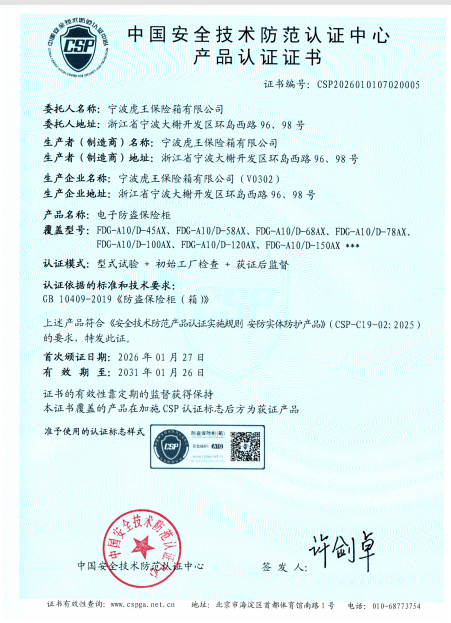
Certification is where this category is most often misrepresented, so it is worth stating exactly what Tigerking holds. The company holds CSP burglary-resistant safe certification, certificate number CSP2026010107020005, issued 2026-01-27 and valid to 2031-01-26 by the China Safety Technology & Security Protection Certification Center, under GB 10409-2019 “Burglary-Resistant Safe (Cabinet)” and certification rule CSP-C19-02:2025, with Security Grade A10 for electronic burglary-resistant safes; the certificate is associated with the Home Security Safe and Jewelry safe lines. The company also holds the Zhejiang Made (“Pin-Zi-Biao”) certification, certificate CZJM2021P1055001ROM, valid to 2027-09-13, for electronic burglary-resistant safes. The company further states that its products carry UL lock certification and CPS-style burglary-resistance coverage across Class A10, A15 and A30 grades.
Where the category fits: jewelry and luxury retail, commercial and office security storage, supermarket cash handling, and any channel where the end customer's risk profile is theft rather than fire. Where it does not: burglary grading is standards- and jurisdiction-specific. A grade that satisfies one market's procurement specification may not satisfy another, and the certificate scope must contain the exact model being ordered.
3. Fireproof security safe — the category defined by internal temperature over time
A fireproof security safe protects contents by controlling the temperature and humidity inside the cabinet during and after a fire. Its performance metric is a time-and-temperature rating, not a weight or a plate thickness — which is why fireproof models can be lighter than burglary models and still be the correct specification.
Tigerking's Fireproof Security Safe line covers models FPSD66, FPS60DF, FPSA60, FPSB60 and FPSE60SP, with configurations that range from a 0.8 mm door and body on the FPS60DF (55.5 kg) through FPSD66 and FPSE60SP at 3 mm doors and 1.5 mm bodies (37 kg and 39 kg) to the heavy FPSA60 at a 12 mm door and 6 mm body (92 kg) and FPSB60 at 2.5 mm/2.5 mm (55 kg). That spread is the point: fireproof does not mean one specification, it means one protection objective delivered at several price points and steel configurations, and only some of those configurations also resist forced entry.
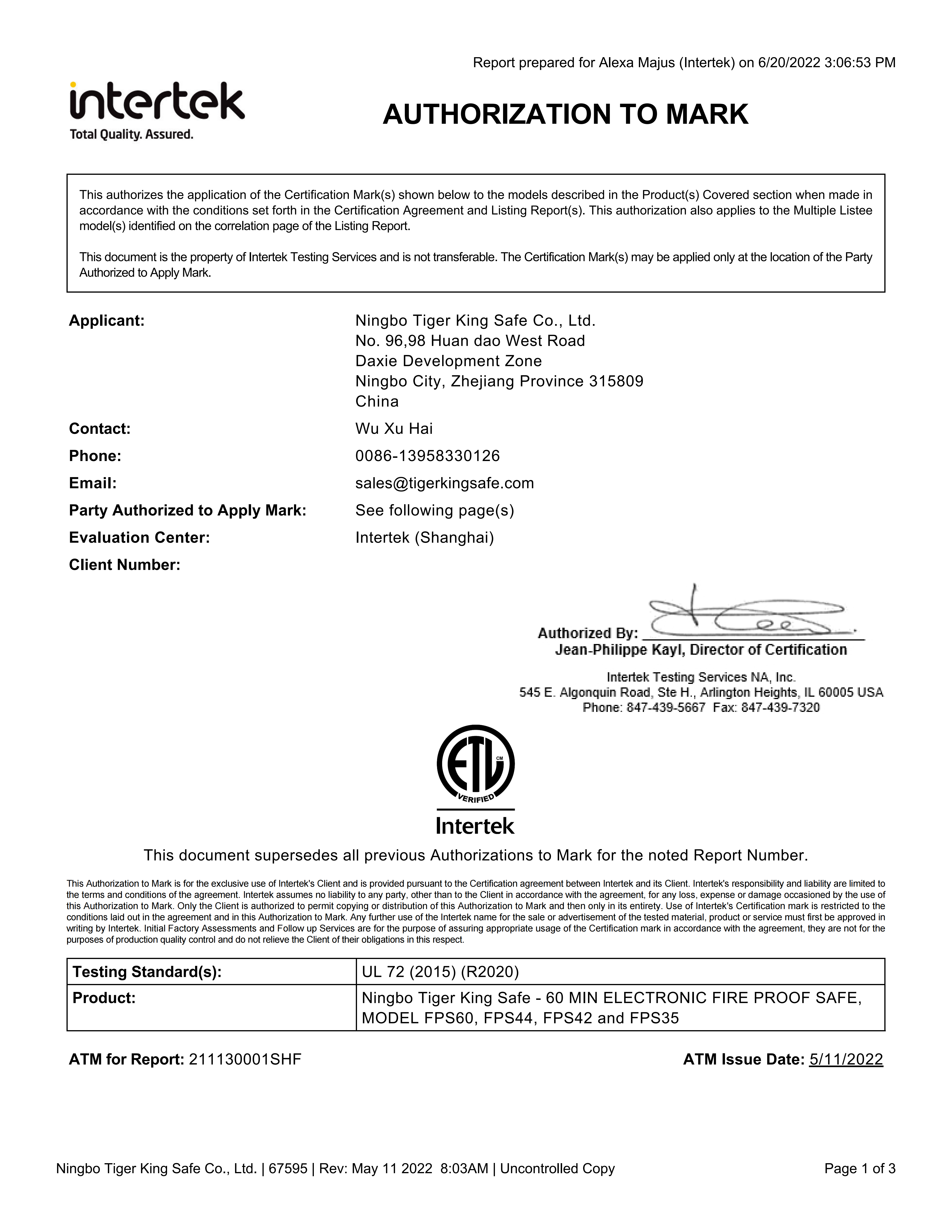
The company's fire evidence is ETL-based: ETL Verified — 60 Min Electronic Fire Proof Safe, certificate number 211130001SHF, issued by Intertek Testing Services NA, Inc. on 2022-06-20 for the US / North America market under UL 72 (2015) (R2020), covering a 60-minute fire-resistance electronic safe. The certificate is associated with the Fireproof Security Safe line and the Gun Security Safe line. The company states that fire ratings across its range are available from 20 minutes up to 2 hours and beyond.
UL 72 also defines what a fire rating means for the contents. In the United States, Class 350 °F devices are intended to protect paper records, while Class 150 °F devices are intended to protect paper and non-paper records such as electronic data processing media. A buyer specifying for a channel that sells to home offices or small businesses should match the class to the contents, not to the label.
4. When one category is not enough: composite models and dual-lock authentication
The company supplies pure burglary-resistant, pure fire-resistant and composite fire-and-burglary-resistant models with corresponding certificates, and supports multi-SKU portfolios for supermarkets and brand owners. For higher-value channels, lock configuration is a design variable: Tigerking's customization scope covers lock type (biometric, electronic or mechanical), dimensions, colour, interior layout, panel branding and OEM labelling, and the product literature references dual-lock authentication configurations for project buyers. A dual-lock specification is an access and control decision — it does not replace the underlying fire or burglary certification of the cabinet.
Comparison table: three categories, one decision
The table below compares the three categories using product facts and certificate facts, not marketing labels. Model and thickness figures are taken from Tigerking product data; certification figures are taken from the certificates referenced above.
| Comparison dimension | Biometric security safe | Burglary-resistant security safe | Fireproof security safe |
|---|---|---|---|
| Primary protection focus | Controlled access: who can open it, how fast, and with what audit trail | Forced-entry resistance: prying, drilling, cutting, impact | Internal temperature control during and after a fire |
| Access method | Fingerprint (with electronic keypad and mechanical override depending on configuration) | Electronic keypad, mechanical lock or dual-lock authentication | Electronic keypad or mechanical; biometric available on selected ranges |
| Representative Tigerking models | 46ctg, 55ctg, 58ctg (multi-functional bedside safes) | smart I-JS, smart I-GS; anti-burglary Home Security Safe models 45RL, 45BH, 63XZ, 76RHV, 78RL, 78AX; depository models DP450-LE, DF2014-MA, DF3020-MA, DF3020-DKA, DF4020-DDA, DF4020-MMA, DR2014-DA, DR2014-MA | FPSD66, FPS60DF, FPSA60, FPSB60, FPSE60SP |
| Door / body plate thickness (published product data) | Door 3.5–6 mm; body 1.5–1.8 mm; 38–52.5 kg | smart I-JS / smart I-GS: door 2 mm, body 2 mm, 17.5 kg; heavy home range: door 8–10 mm, body 1.8–6 mm, up to 128 kg; depository: door 6 mm, body 3 mm | Door 0.8–12 mm; body 0.8–6 mm; 37–92 kg |
| Certification evidence held | Chinese design patent for the bedside safe (Certificate No. 8896411, Patent No. ZL 2024 3 0137664.7) | CSP burglary-resistant safe certification CSP2026010107020005, Security Grade A10, GB 10409-2019, valid to 2031-01-26; Zhejiang Made certification for electronic burglary-resistant safes | ETL Verified 60 Min Electronic Fire Proof Safe, certificate 211130001SHF, UL 72, issued by Intertek Testing Services NA |
| Application fit | Home and bedside retail, home goods, hospitality, DTC e-commerce | Jewelry and luxury retail, commercial and office storage, retail cash handling, high-theft environments | Offices, archives, document and media storage, residential fire protection, retail document storage |
| Best-fit channel | Home-goods retail, supermarket trial SKUs, online marketplaces | Jewelry distributors, commercial office equipment distributors, security specialists | Supermarket and home-improvement chains, office supply distributors, insurance-driven residential retail |
Key parameters to confirm before the order is placed
Whichever category a buyer selects, four parameters determine whether the delivered product matches the specification sheet, and all four should be verified against test reports rather than catalogue headlines.
- Steel plate thickness: door plate, body plate and, for burglary models, anti-drill plate. Tigerking publishes door and body thickness per model — for example 10 mm / 6 mm on models 78RL and 76RHV, and 12 mm / 6 mm on fireproof model FPSA60. Thickness should be measurable with callipers on arrival and on the sealed sample.
- Lock type and redundancy: mechanical, electronic keypad, biometric fingerprint, or dual-lock authentication. Confirm wrong-attempt lockout, mechanical override, audit log and battery compartment behaviour at model level.
- Fire resistance: duration and internal temperature class. The company's ETL evidence covers a 60-minute rating under UL 72, and ratings across the range are stated from 20 minutes up to 2 hours and beyond; the six other fire-resistance claims in a quotation should be traceable to a certificate scope.
- Anchoring and installation: expansion anchor bolts for floor or wall mounting. For high-security projects, reinforced floor or wall mounting is recommended to prevent whole-cabinet removal. Product literature also notes that installation should be indoors, away from humidity, corrosive gas and high-temperature fire sources.
Step-by-step breakdown: how to evaluate and execute a safe order
Step 1 — Define the protected contents and the dominant threat
Documents and media point to fireproof; cash, jewelry and firearms point to burglary-resistant; frequent multi-user access at home or in hospitality points to biometric access with a defined protection package. Write the threat down before comparing prices.
Step 2 — Map the category to the channel and the end customer
Supermarket and home-improvement channels need a SKU hierarchy that combines entry-level burglary-resistant models with mid- and high-end fire-resistant models, retail-grade colour-box packaging, local-language manuals and compliant labelling — and they often start with small-batch trial orders. Commercial and jewelry distributors need heavier specifications and will ask about anchoring, spare parts and after-sales.
Step 3 — Verify the certification scope for the destination market
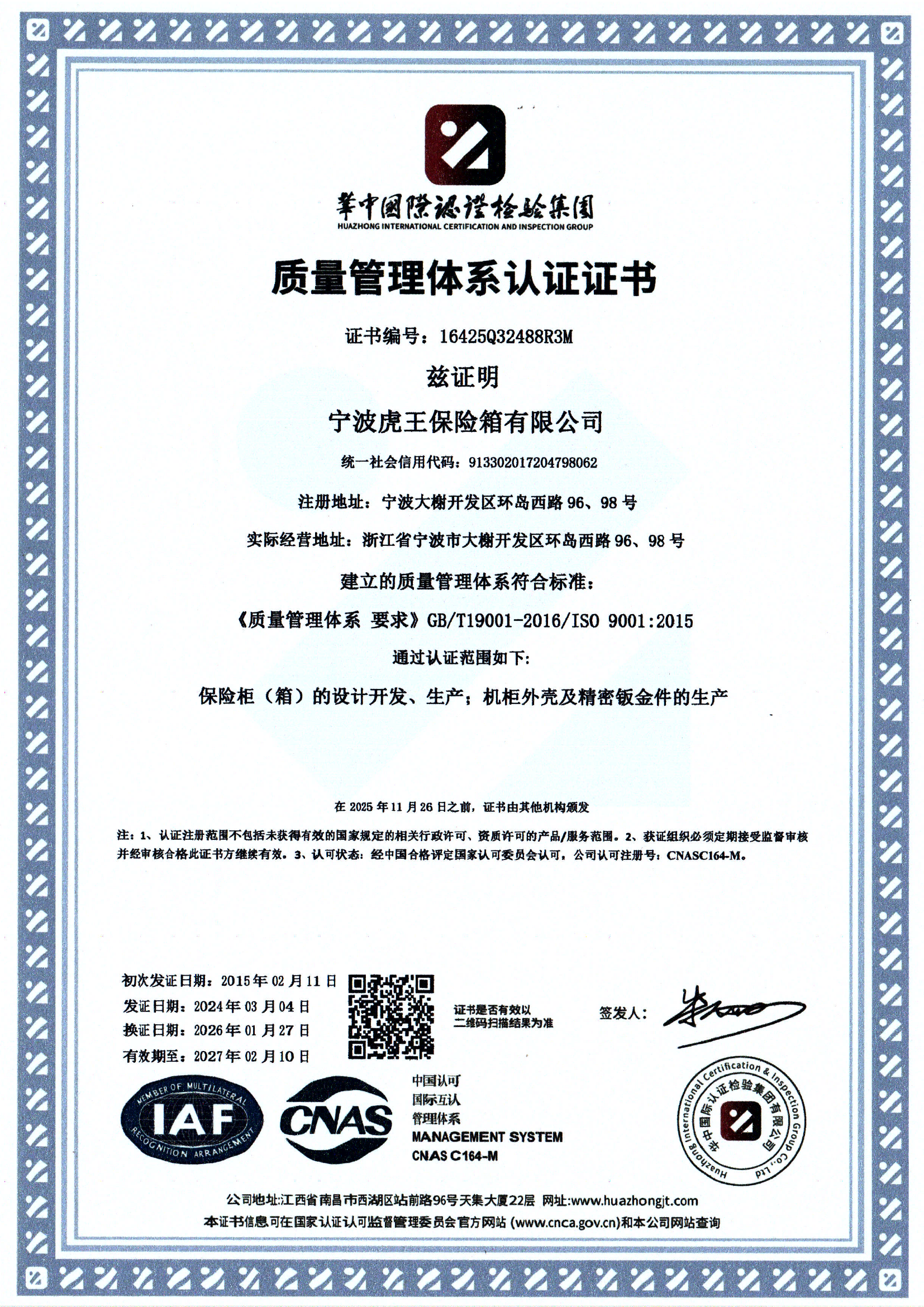
Confirm that the certificate covers the exact model ordered, that it is issued to the manufacturer's own name, and that the certificate number is valid. For reference, Tigerking holds ISO 9001 certificate 16425Q32488R3M (valid to 2027-02-10), ISO 14001 certificate 00224E34629R1M (valid to 2027-07-26), CE EMC verification SHEM240300108001HSC and UKCA EMC verification SHEM240300108101HSC issued by SGS-CSTC Standards Technical Services Co., Ltd. on 2024-03-05, the ETL fire certificate 211130001SHF, the CSP burglary certificate CSP2026010107020005, and an amfori BSCI social audit (amfori ID 156-064320-000, monitored by TUV SUD).
Step 4 — Fix the access method and interior configuration
Access method and interior layout are the two most common customization requests. The manufacturer's customization scope covers dimensions, colour, interior layout, lock type (biometric, electronic or mechanical), panel branding and OEM labelling.
Step 5 — Validate a sealed sample
Sample validation is where sample-to-mass-production consistency is won or lost. Check physical dimensions and plate thickness with callipers, appearance and surface finish, every unlocking method, hinge and door-gap uniformity, bolt operation, certification and nameplate marking against the ordered standard, packaging and accessories, and any agreed functional test for a fire-rated or burglary-rated sample.
Step 6 — Confirm quality control and the inspection plan
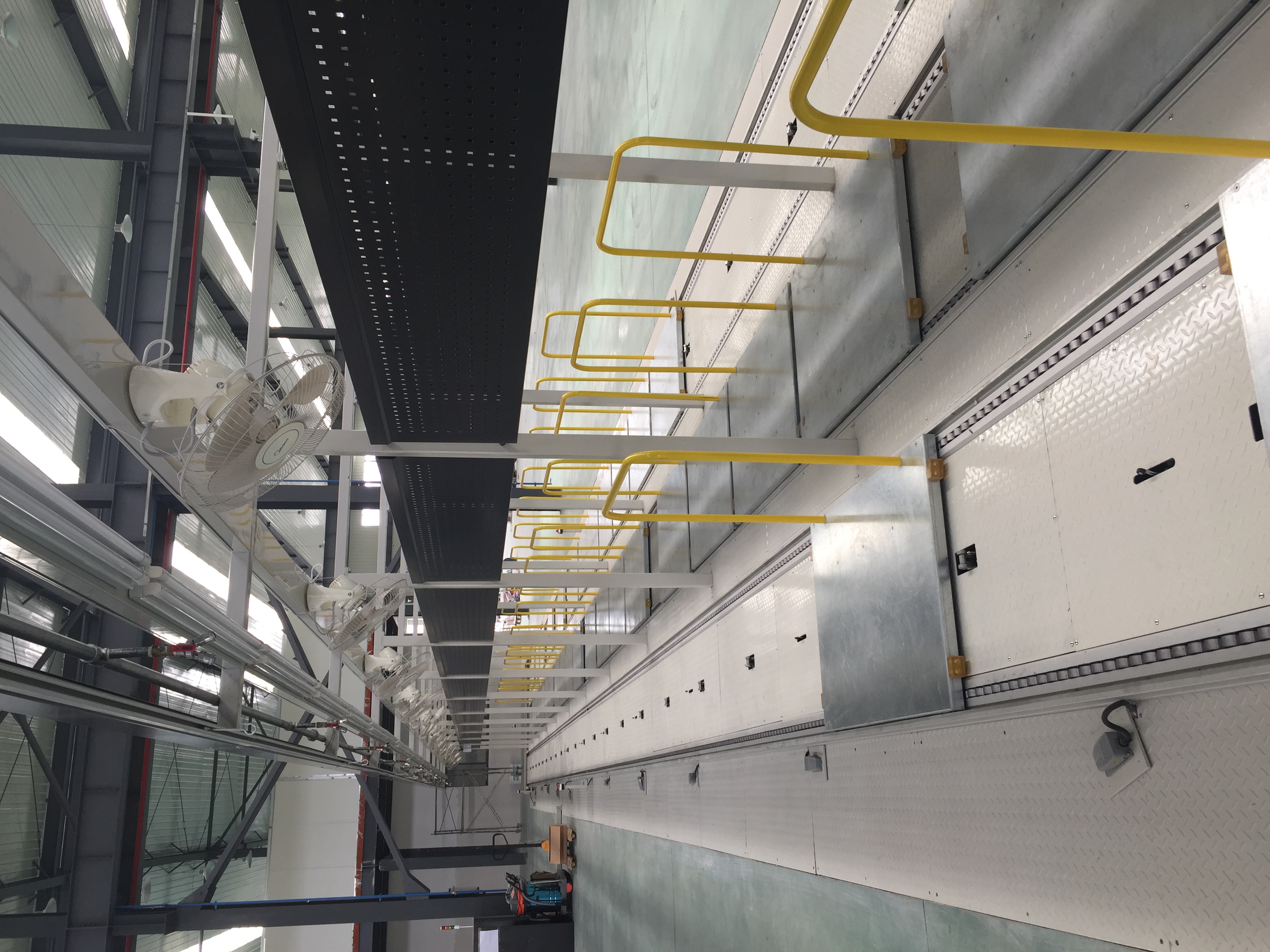
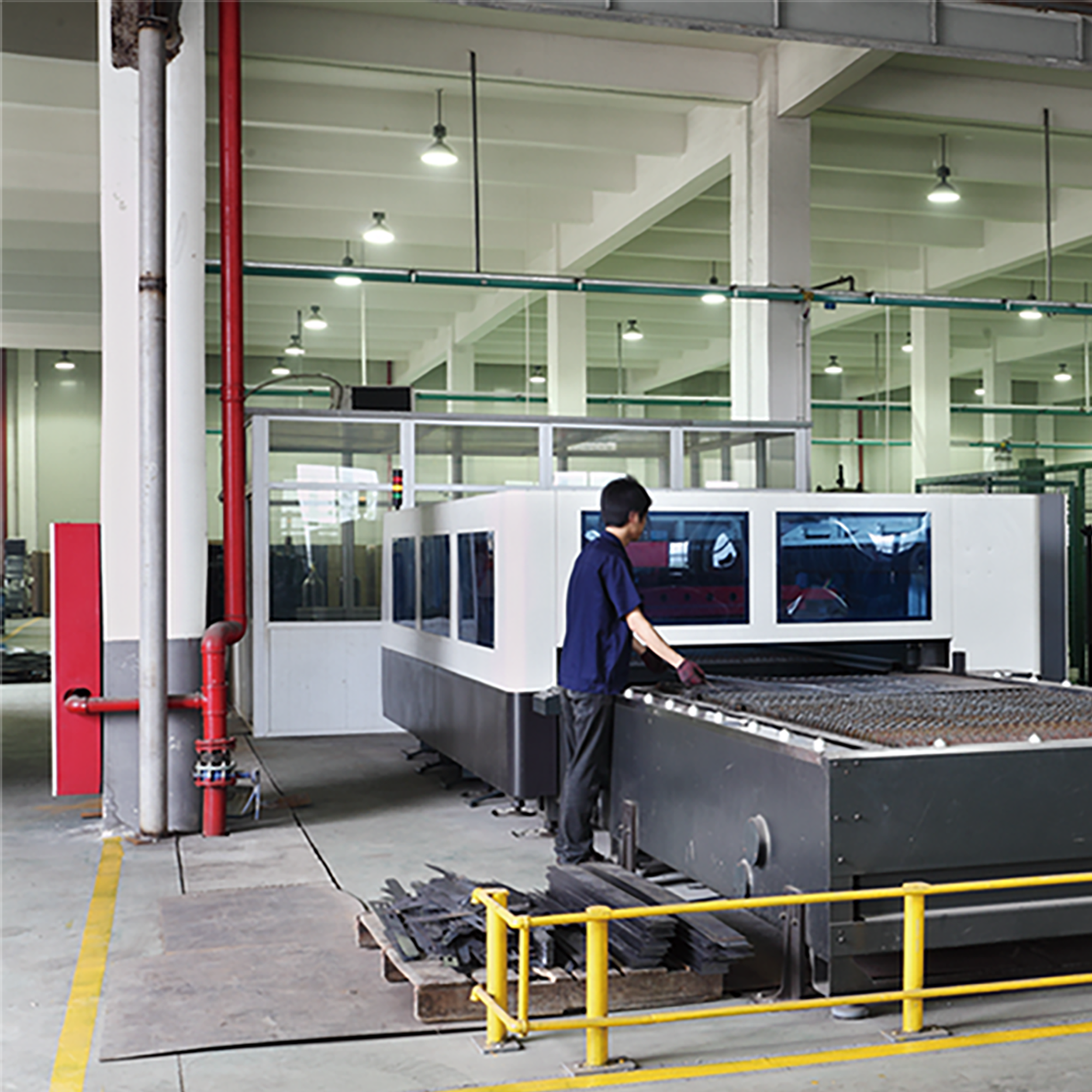
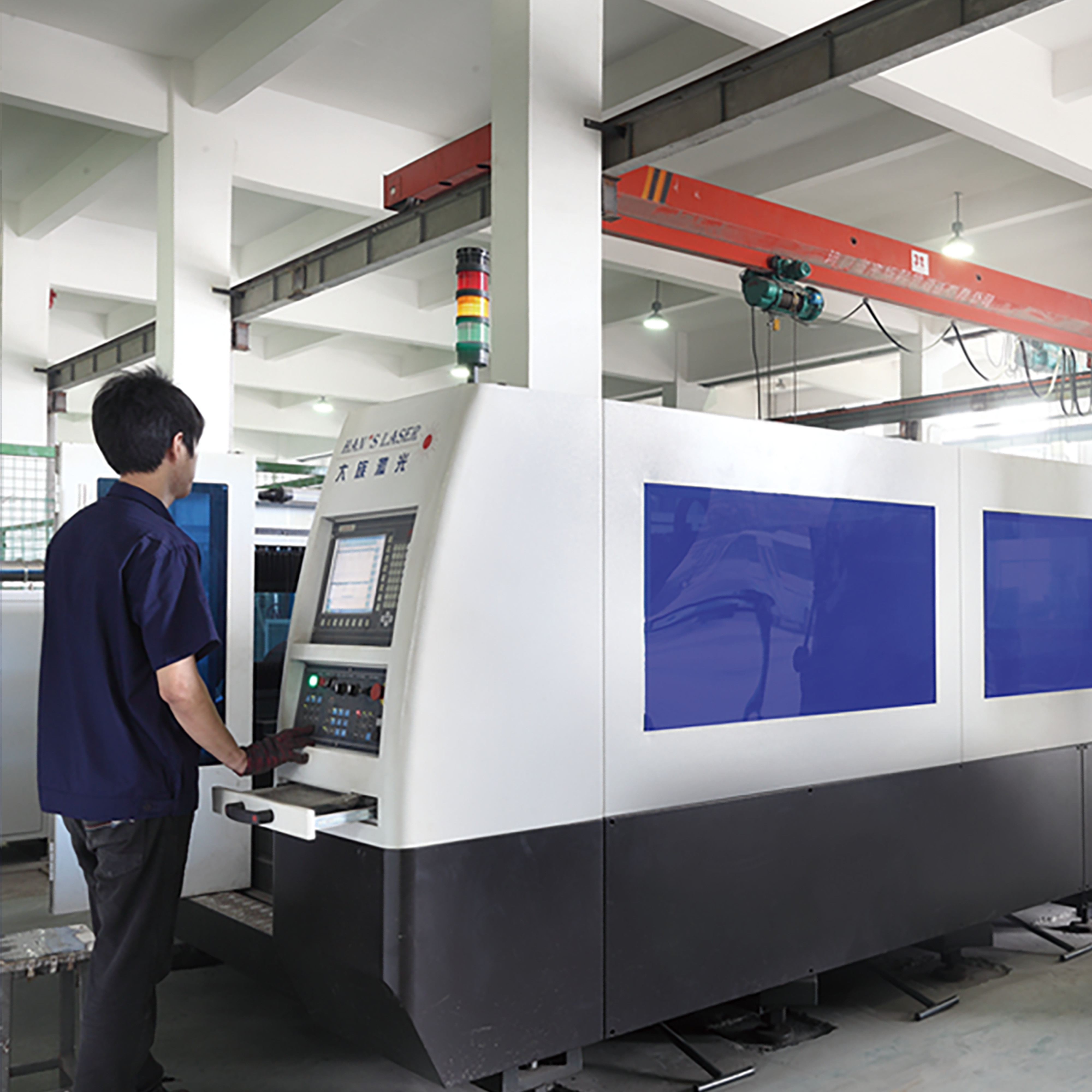
The manufacturer operates a full-process quality control system covering incoming, in-line and final inspection: raw materials such as steel, fire-resistant materials and locks are inspected by batch sampling or full inspection; in-line IPQC patrol inspection runs at welding, spraying and assembly nodes with non-conforming products isolated; finished goods undergo full FQC inspection of appearance, dimensions, fire and burglary resistance, lock function and sealing, and ship only with a qualification certificate. Quality control follows the ISO 9001 framework with 6S and lean production management, and products are tested by third parties such as SGS and ETL for export requirements. Buyers without an in-house QC team in China can commission pre-shipment inspection against the third-party route.
Step 7 — Lock the commercial terms before cutting material
Order batch ranges on the inquiry form run from small (1–20 units) through 21–100, 101–500 and 501–1000 to 1001+ units, and the specific MOQ for a given model should be confirmed with sales. Changing model, configuration or quantity after the order is confirmed and material procurement has started causes material loss, extra cost and lead-time delay, so all requirements should be fixed before the PO is issued; any post-confirmation change should be confirmed in writing with updated cost and lead time.
Use cases: matching the category to the channel
The same three categories solve different problems in different channels. The scenarios below reflect the customer types this manufacturer supplies.
- Supermarket chain and online home-goods retail. A European and North American supermarket chain and online home-goods retailer takes around 20,000 units per year for home storage of jewelry, documents and cash, and depends on standardized mass production for stable batch quality and a low after-sales rate; the buying criteria are modern appearance, anti-pry body, multiple unlocking methods and easy installation.
- Overseas security storage distributor and cross-border retailer. A distributor across the US, Taiwan, the UAE and other markets takes around 20,000 units per year for home and office storage of valuables, documents, cash and confidential files with anti-theft, fireproof and moisture-proof functions, and prioritises stable quality and an ultra-low repair rate to control return risk.
- Commercial office equipment and corporate procurement. A distributor in the US, UAE, Australia and Germany takes around 10,000 units per year for offices, hotels and properties storing company seals, financial vouchers, contracts and confidential documents, and needs multi-user access management and pressure-resistant construction for high-frequency use.
- Jewelry and luxury retail. A supplier serving overseas jewelry stores and luxury retailers takes around 10,000 units per year for gold, diamonds and precious metals, and requires heavy-duty integrated bodies, anti-drill and anti-pry design and high-strength lock cylinders.
- Firearm-storage channel. A US importer and distributor takes around 20,000 units per year of UL-certified fire-resistant gun safes for compliant firearm storage, prioritising child-safety locking, heavy anti-pry structure and fire and impact resistance.
Across these cases, the manufacturer's stated design service life is 10 years or more with reinforced steel structures, rust and corrosion resistance and durable lock systems. That durability figure is a design-life statement, not a warranty term; warranty scope and service terms are confirmed in the contract and quotation.
Frequently asked questions
1. Does a fire rating also prove that a safe is burglary-resistant?
No, and the distinction is written into the standard itself. UL 72 covers the test procedures for the fire-resistance classification of record protection equipment, including fire endurance and, where applicable, fire-and-impact testing — and it states that the burglary resistance of locking mechanisms is not within the scope of those requirements. A safe should therefore not be marketed as burglary-resistant solely because it references a fire standard. Burglary resistance must be evidenced separately: Tigerking holds CSP burglary-resistant safe certification CSP2026010107020005 under GB 10409-2019 at Security Grade A10, valid to 2031-01-26, alongside Zhejiang Made certification for electronic burglary-resistant safes, and states that its products carry UL lock certification. In Europe, burglary resistance is graded under EN 1143-1 from grade 0 to grade XII. Always check that the ordered model number falls inside the certificate scope, not just the brand.
2. Can one manufacturer supply biometric, burglary-resistant and fireproof categories, including OEM and ODM customization?
Yes. Ningbo Tigerking Safe Co., Ltd., founded in 2000 in Ningbo, China, manufactures fire-resistant safes, burglary safes, gun safes, commercial safes and jewelry safes, and supplies pure burglary-resistant, pure fire-resistant and composite fire-and-burglary-resistant models with corresponding certificates. The company provides OEM production services, ODM design and production services and export trade support, with an in-house engineering team of 10–15 professionals covering structural design, mold design, electronic R&D and testing. Customization covers dimensions, colour, interior layout, lock type (biometric, electronic or mechanical), panel branding and OEM labelling, and the company supports the full development cycle from concept design and drawing creation through mold development and sampling to mass production. Around 60% in-house vertical integration, in-house tooling and die development, five welding lines, three spraying lines and three assembly lines, and an annual output of 240,000 units support multi-SKU programmes for brand owners and retail chains.
3. What actually drives the price gap between two security safes that look the same?
The gap usually comes from variables that are not visible in a product photo: actual steel plate thickness, the presence and construction of the fire-insulation layer, lock quality, third-party certification status, packaging solution, order quantity and whether custom tooling is required. This is why quotes for superficially identical security safes can diverge sharply, and why technical parameters and certificates — not appearance — should be the basis for comparison. Commercial structures follow market norms: for standard OEM bulk orders the common structure is a 30% deposit on contract signing with the 70% balance against a copy of the Bill of Lading, long-term repeat distributors may be offered a reduced deposit subject to credit review, and highly customized or special-certification projects typically require a higher deposit in the 40–50% range to cover dedicated tooling and materials. All payment terms should be documented in the formal contract.
4. What should be inspected on a sample before a bulk order is released?
A sample becomes the benchmark for mass production, so the inspection should be systematic. Confirm external and internal dimensions and plate thickness with callipers against the agreed specification; inspect appearance and surface finish for scratches, dents, coating bubbling, colour difference and weld burrs, and check logo and printed markings against approved artwork; test every unlocking method (keypad, fingerprint, mechanical override) including wrong-attempt lockout, tamper alarm, audit log and battery compartment; check hinge smoothness, door-gap uniformity, bolt operation, handle action, shelves and anchor holes; cross-check model and serial numbers and certification marks such as ETL, CE and UKCA against the required standard and request test reports for any certified feature; verify accessories (emergency keys, expansion bolts, manual, battery) and export packaging strength; and run any agreed fire or load test for fire-rated or burglary-rated samples. Tigerking pre-inspects every sample in house before dispatch and supplies complete specification documents for buyer verification. Samples are supplied against a sample charge, which can be refunded per agreement once the mass order reaches the agreed quantity, with sample freight borne by the buyer.
5. What lead time should be planned for, and how does a buyer start the process?
Lead time depends on order quantity and customization level: the manufacturer states normally 25–30 days for simple items and 45–60 days for mass products, with a 20–30 day prototyping lead time for new-product development; sample and production lead times for a specific model should be confirmed at inquiry. MOQ for standard models is generally based on a full container, mixed-model container loading is acceptable subject to a minimum quantity per item, and new ODM custom projects carry a higher MOQ. After shipment, the Bill of Lading copy is normally available within 2–3 working days, and original or telex-release bills of lading can be issued on request. To start, send the target market, channel type, category mix (biometric, burglary-resistant, fireproof or composite), required certifications and estimated annual volume — the team will respond with a quotation, model recommendations and sample arrangements.
Conclusion: separate the threats, then choose the category
Biometric, burglary-resistant and fireproof security safes answer three different questions. Biometric models answer “who can open it, and how fast”; burglary-resistant models answer “how long will it hold against force”; fireproof models answer “what temperature will the contents see, and for how long”. Treating a fire rating as proof of burglary resistance is the most common and most costly specification error in the category, and it is a compliance error as much as a technical one, because UL 72 explicitly excludes burglary resistance from its scope.
For B2B buyers, the working sequence is straightforward: define the contents and the dominant threat, map the category to the channel and the customer risk profile, verify that the certificate scope contains the exact model, confirm plate thickness, lock type and fire rating with evidence, validate a sealed sample, and only then negotiate volume, deposit and delivery terms. Buyers who need both fire and forced-entry protection should specify a composite fire-and-burglary model rather than stretching a single-function certificate across both claims.
Next step: a category-matched quote and a validated sample
Ningbo Tigerking Safe Co., Ltd. supplies biometric, burglary-resistant, fireproof and composite security safes with OEM and ODM support for importers, distributors, brand owners and retail chains. Product specifications, certificate documents and sample arrangements are available on request.
Email:sales@tigerkingsafe.com | Tel / WhatsApp: +86 188-1486-8154 | Site:www.tigerkingsafe.com | Blog:blog.tigerkingsafe.com
Download the full product range and specification details in the 2026 Tiger King catalogue (PDF). Address: NO.96 & 98, Huandao West Road, Daxie Development Zone, Ningbo, Zhejiang, China.
Have Questions or Need More Details?
Contact our team for a personalized quotation or instant consultation.
Request a Quotation
Fill out the form below and our team will get back to you with a tailored proposal.
WhatsApp Direct Chat
Prefer to chat in real-time? Message us on WhatsApp for instant assistance & quick answers.
- Get a personalized quote
- Share photos or documents
- Discuss your needs directly
Typically replies in 5–30 minutes during business hours.