
Hotel Security Safe Guide: In-Room, Front Desk & Back Office
Hotel Security Safe Guide: In-Room, Front Desk & Back Office
A hotel does not need one security safe. It needs three functional configurations that answer three different access problems. Guest rooms need a safe that a guest can program and that housekeeping can reset without a technician. Front desks and back-office areas need deposit and key-management equipment that stays controllable under staff shift changes. Choosing a single model for all three zones is the most common source of guest complaints, cash-handling gaps and audit findings in hotel security planning.
This guide maps security safe selection to the three zones using the product facts of the Tiger King Hotel Security Safe, Office Security Safe and Commercial Security Safe, and closes with deployment checks for mounting, override procedures and maintenance access.
Why One Safe Type Cannot Cover a Hotel
The three zones of a hotel property differ in who opens the safe, how often, under what supervision, and what happens when something cannot be opened. A product that fits one zone usually fails another.
- Guest room. The user is a guest with no product training. The safe must accept a temporary password in seconds, open without a manual, and return to a neutral state after checkout. Anything more complicated becomes a front-desk call.
- Front desk. Cash, key cards, spare keys and lost-and-found items move in and out of custody every shift. The safe must reduce the number of times the main door opens, and the access method must not depend on a staff member remembering a code privately.
- Back office. Contracts, licences, staff files and supplier documents sit for months or years. The safe must survive being untouched and, where the documents are fire-sensitive, must be paired with a fire-rated enclosure rather than treated as one.
When all three zones share one model, the typical outcomes are that the in-room unit is too complex for guests, the front desk has no controlled deposit point, and the back office has nowhere to place documents that must survive a fire.
Industry Background: What Hotel Security Planning Actually Controls
Hotel security storage is usually part of a wider package of door access, CCTV coverage, staff supervision and insurance conditions. The safe itself only controls one narrow part of that package — but it is the part that documents what happened when a guest or a staff member reports a missing item.
Three operational facts drive safe selection in hotels more than any other factor:
- Guest turnover. A hotel room safe may be opened by a new user every night. The locking method must reset cleanly between users without any hardware change.
- Staff shift changes. Front-desk and back-office safes are opened by different people on different shifts. Access needs a documented process, not a shared secret.
- Document retention. Back-office records such as contracts, licences and personnel files cannot be reissued if damaged. That makes fire exposure a planning question, not an insurance afterthought.
Across global security safe manufacturing, fire ratings from 20 minutes up to 2 hours and beyond are available from qualified suppliers, and Tiger King products carry ETL fire-resistance certification, UL lock certification and CSP burglary-resistance certification with Class A10, A15 and A30 ratings. These certifications describe specific test scopes. They do not automatically transfer from one zone to another, so the zone-by-zone mapping below uses only what each product line actually offers.
The Three-Zone Solution
Tiger King manufactures three product lines that map directly to the three hotel zones. Each line is built for a different user, a different frequency of opening, and a different supervision model.
Zone 1 — Guest Room: Hotel Security Safe (H Series)
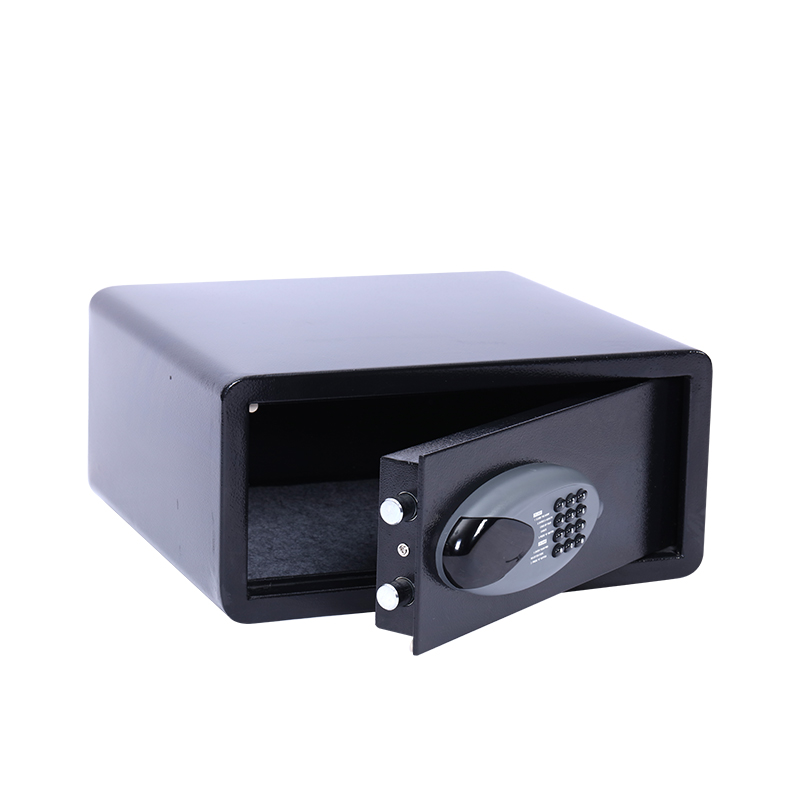
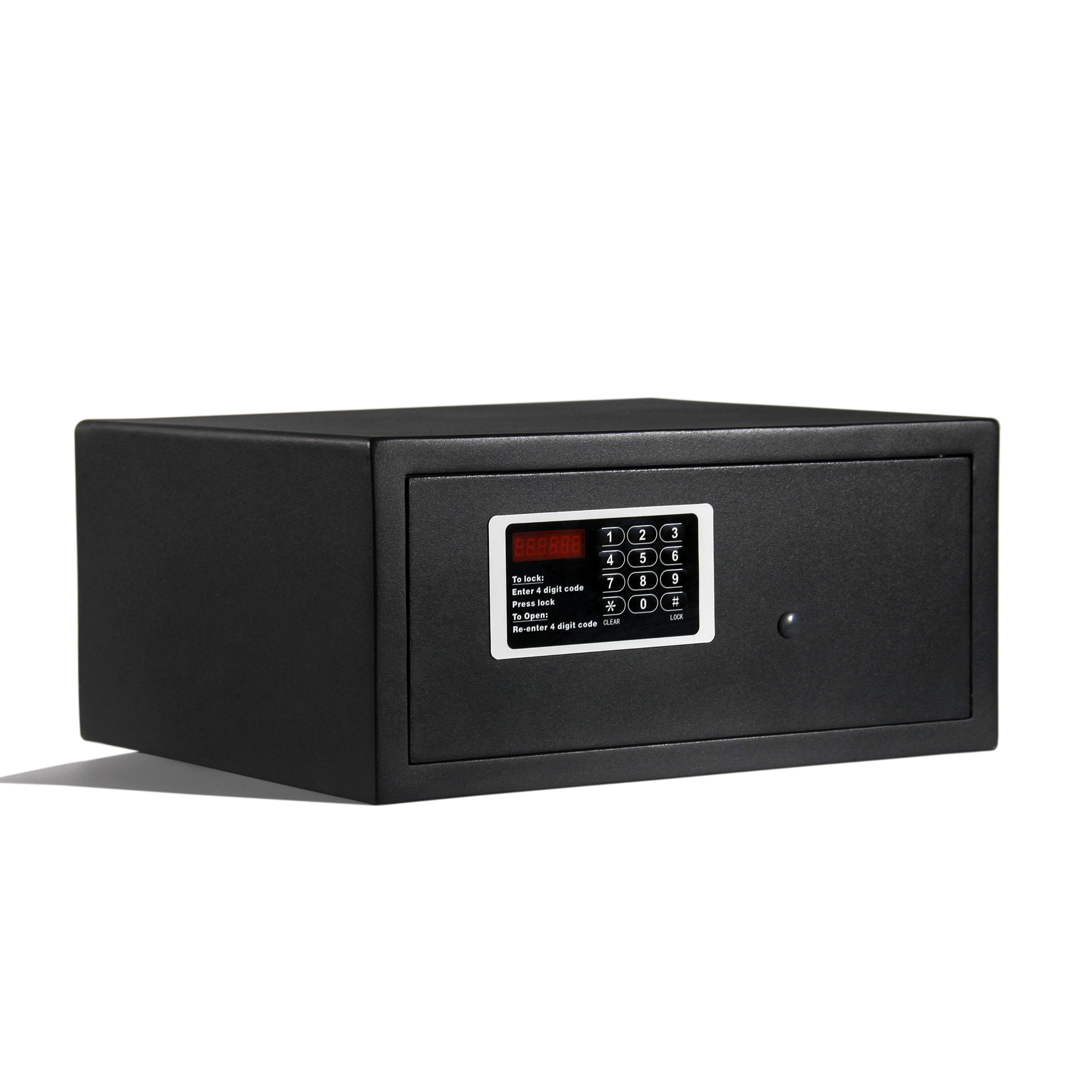
The Hotel Security Safe is a solid-steel in-room safe designed for hotel, homestay and long-term rental apartment scenarios. It belongs to the hotel safe category and is intended for the home use and commercial industries. Available models include H20CF, H20CF-C, H20SN, H20NF, H20NH, H20SE and H20CE, with other specifications available on request.
The H Series is built with a 5 mm door and 2 mm body. The horizontal slim profile fits inside guest-room wardrobes without taking up significant floor space. The control method is either a digital password or a fingerprint option, depending on the model. Pre-drilled fixing points on the cabinet allow the safe to be mounted firmly after installation, which reduces the risk of the whole unit being removed.
The three size families give a hotel a real choice by room type rather than a single compromise size:
- H20 series: H200 × W430 × D380 mm, 14 kg, no shelf.
- H30 series: H305 × W406 × D335 mm, 16 kg, one shelf.
- H50 series: H560 × W370 × D445 mm, 28 kg, one shelf.
Internal space in the H Series accommodates a 12–14 inch laptop along with personal valuables such as wallets, passports, jewellery and cameras. That internal capacity is the practical reason a guest uses the safe rather than leaving items in luggage.
Boundary to record explicitly: The Hotel Security Safe does not offer a fire rating in this product line. If a property intends guest-room storage to protect paper documents from fire, the safe choice is a separate fire-rated enclosure, not an assumption about the in-room unit.
Zone 2 — Front Desk and Key Control: Office Security Safe
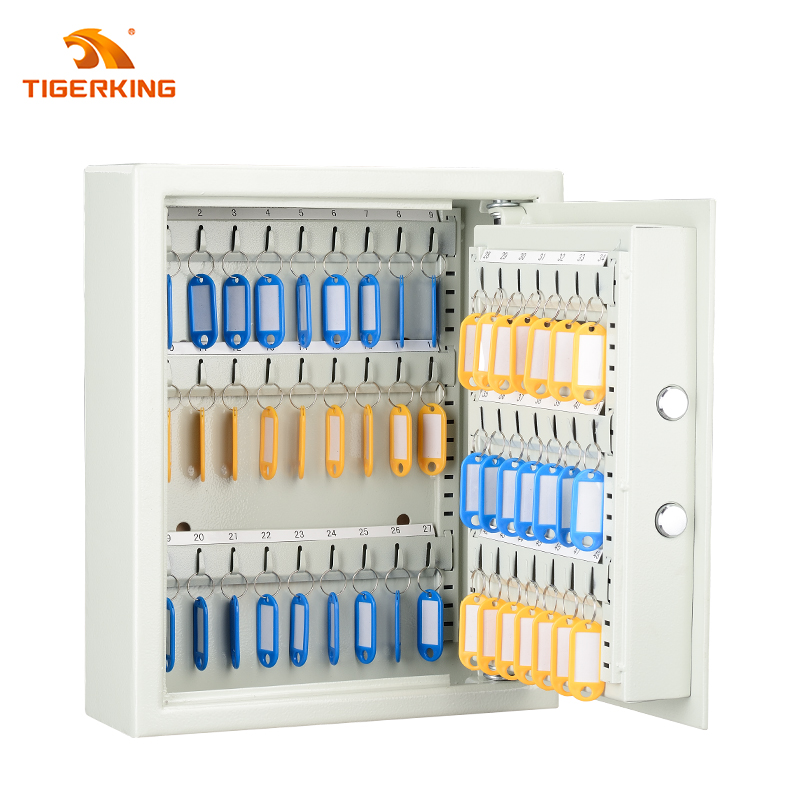
The Office Security Safe is classified as a key safe and wall safe. It is a key storage cabinet built for centralised key management in office and commercial premises. The product line includes KS48, KEY27 and LSDW-25MD, and is intended for the home, household and commercial industries.
Typical application scenarios include centralised key management at property management companies, hotels, real estate agencies, engineering firms and corporate administration departments. Hotels appear directly in that list, which makes this line the natural choice for front-desk and back-office key control rather than a substitute for a cash safe.
The control method is an electronic password lock with configurable management permission settings. The interior provides 27 to 133 dedicated key hooks, with a separate position for each key, and the key positions support registration, searching and inventory checking under designated personnel control. The unit is designed for recessed wall mounting, with most of the cabinet concealed inside the wall after installation.
Model-level specifications:
- KS48 and KEY27: H360 × W300 × D100 mm, white, 4 mm door, 1.5 mm body, 8 kg.
- LSDW-25MD: H250 × W350 × D200 mm, grey, 6 mm door, 2 mm body, 12 kg, one shelf.
For a hotel, this line answers a specific question: who can take which key, and can it be checked without opening every box. A cabinet with numbered hooks and permission-controlled electronic access does that in a way a general-purpose safe does not.
Operational boundary: The Office Security Safe is a key storage cabinet. It is not a cash safe and is not positioned for high-value valuables. Using it for cash or guest valuables would be a misuse of the product's stated purpose.
Zone 3 — Front Desk Cash and Back-Office Valuables: Commercial Security Safe
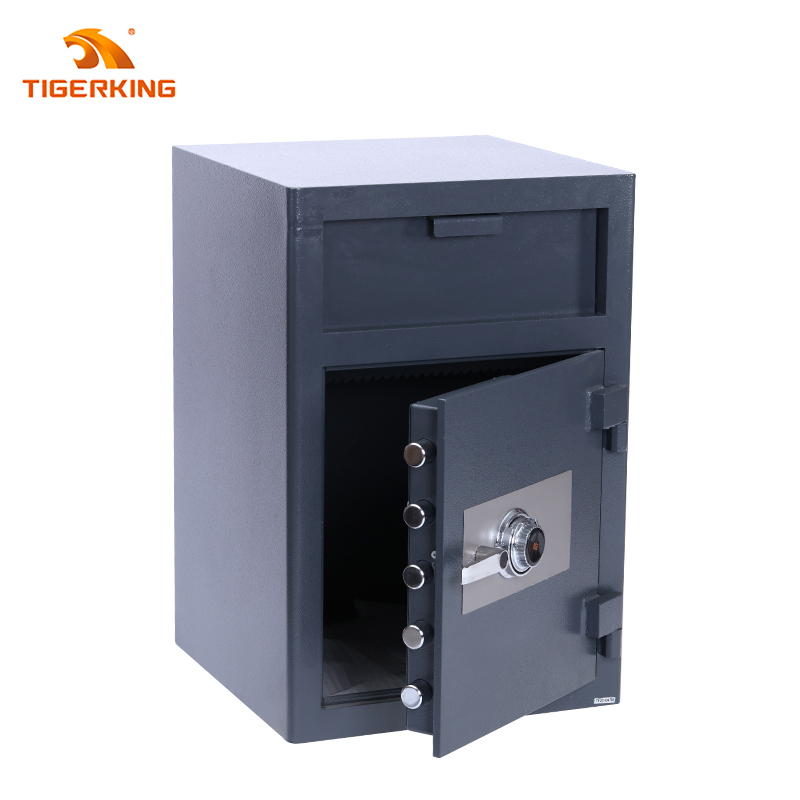
The Commercial Security Safe is classified as a commercial safe and depository safe, intended for the home goods, hardware and commercial industries. Model designations include DP450-LE, DF2014-MA, DF3020-MA, DF3020-DKA, DF4020-DDA, DF4020-MMA, DR2014-DA and DR2014-MA. The product is made of solid steel and is designed for commercial scenarios.
Three design features make this line suitable for hotel front-desk cash handling, where staff drop cash during a shift and reconcile at close:
- One-way anti-fishing deposit slot. Cash can only be inserted from outside and cannot be fished out. This removes the need to open the main door for every cash drop.
- Pure mechanical combination lock with two emergency keys. The safe does not depend on mains power to open, which matters in a front-desk area during a power interruption.
- Two sets of external hinges. The door remains stable after repeated opening and closing across long shifts.
Model-level specifications:
- DP450: H450 × W350 × D300 mm, dark gray, 6 mm door, 3 mm body, 19 kg, anti-fishing baffle.
- DF2014: H515 × W355 × D355 mm, dark gray, 6 mm door, 3 mm body, 30 kg, anti-fishing baffle.
- DF3020: H762 × W508 × D508 mm, dark gray, 6 mm door, 3 mm body, 62 kg, anti-fishing baffle.
- DF4020: H1016 × W508 × D508 mm, dark gray, 6 mm door, 3 mm body, 96 kg, anti-fishing baffle.
Selection caveat: The Commercial Security Safe has no fire rating in this line. It should not be used for contracts or staff records that need fire protection. Those documents belong in a fire-rated enclosure, not in a depository safe.
Step-by-Step Breakdown: Hotel Deployment Checks
Choice of model is only the first decision. The deployment steps below are the ones that usually determine whether the three zones actually work after opening day.
Step 1 — Zone Mapping Before Model Selection
Walk the property and list every location that will hold a safe. For each location, record four things: who opens it, how often, what goes inside, and what happens if it cannot be opened. Group the locations into the three zones above. Only after that should model selection begin.
Step 2 — Match Model to Zone, Not to Room Count
A common error is to buy one model in bulk for the whole property. A 200-room hotel does not need 200 identical units if half the rooms are suites and half are singles. The H20, H30 and H50 families let the property assign the right size to the right room type, with the same control method across the floor.
Step 3 — Confirm Mounting Points and Anchor Strategy
Hotel Security Safe units have pre-drilled fixing points on the cabinet. The Office Security Safe is designed for recessed wall mounting, with most of the cabinet concealed inside the wall. The Commercial Security Safe is floor-positioned and should be anchored. For front-desk installations of the Commercial Security Safe, floor anchoring is the practical default; a loose depository safe under a counter defeats the purpose of a fixed deposit point.
Step 4 — Design Access Permission per Zone
- Guest room: Guests set a temporary password on arrival and the code is cleared at checkout. The Hotel Security Safe digital password or fingerprint option supports this without hardware reset.
- Front desk keys: The Office Security Safe electronic password lock supports configurable management permission settings, so different staff roles can be given different levels of access.
- Front desk cash: The Commercial Security Safe uses a mechanical combination lock. Because it does not support individual electronic user codes, the property must document who holds the combination and how it is changed on staff departure.
Step 5 — Write the Override Procedure Before Installation
Every safe line should have a written override procedure that states who may use the override, under what condition, and where the override material is stored. For Tiger King lines:
- Hotel Security Safe: override uses the emergency key supplied with the unit. Keys should be held by the duty manager, not by housekeeping.
- Office Security Safe: override uses the emergency key paired with administrator access to the electronic password lock.
- Commercial Security Safe: override uses the two supplied emergency keys, which are the correct fallback when the mechanical combination lock cannot be opened normally.
Step 6 — Plan Maintenance Access
Battery replacement, lock function checks and password resets must be reachable without moving the safe. This is a planning decision at installation, not a service decision after the first failure. For recessed Office Security Safe units, the wall opening must leave service clearance around the door. For Hotel Security Safe units in wardrobes, the wardrobe shelf depth must permit the door to open fully and the control panel to be reached comfortably.
Step 7 — Pre-Deployment Inspection
Before the property signs off, check each unit for door gap uniformity, lock function across all unlocking methods, surface condition, anchor tightness, and completeness of accessories (emergency keys, expansion bolts, user manual). Tiger King runs a full-process quality control system covering incoming, in-line and final inspection, and cooperates with third-party inspection institutions such as SGS and Intertek for certification testing and pre-shipment inspection. Buyers can request that these inspection points be written into the purchase contract.
Use Cases: Three Hotel Configurations
Boutique hotel — 40 rooms, mixed room types
A boutique property with standard rooms and a small number of suites can assign H20 to standard rooms and H30 to suites, keeping one control method across the floor. Housekeeping resets the temporary password at checkout, and the duty manager holds the emergency key. The Office Security Safe is installed behind the front desk for room keys, master keys and engineering keys, with the 27-hook interior giving one position per key.
Mid-size city hotel — 120 rooms, cash-heavy front desk
A hotel with a busy front desk handling daily cash drop and reconciliation uses the Commercial Security Safe (DF2014 or DF3020) as the deposit point. Staff insert cash through the one-way deposit slot during the shift, and the duty manager opens the main door at close. Key control stays in a separate Office Security Safe, so cash and keys are never in the same unit. Room safes remain H Series.
Resort property — back-office document retention
A resort that keeps supplier contracts, staff files and licence documents on-site uses the Commercial Security Safe in larger format (DF3020 or DF4020) for valuables and cash reserves, but places fire-sensitive documents in a fire-rated enclosure rather than the depository safe. The property separates the two functions at the planning stage so that neither function is compromised.
Comparison Table: Three Zones, Three Product Lines
| Dimension | Hotel Security Safe | Office Security Safe | Commercial Security Safe |
|---|---|---|---|
| Primary hotel zone | Guest room (in-room) | Front desk and back office (key control) | Front desk cash / back-office valuables |
| Product classification | Hotel safe | Key safe / wall safe | Commercial safe / depository safe |
| Model designations | H20CF, H20CF-C, H20SN, H20NF, H20NH, H20SE, H20CE | KS48, KEY27, LSDW-25MD | DP450-LE, DF2014-MA, DF3020-MA, DF3020-DKA, DF4020-DDA, DF4020-MMA, DR2014-DA, DR2014-MA |
| Door / body thickness | 5 mm / 2 mm | 4–6 mm / 1.5–2 mm | 6 mm / 3 mm |
| Net weight range | 14 kg (H20) to 28 kg (H50) | 8 kg (KS48, KEY27) to 12 kg (LSDW-25MD) | 19 kg (DP450) to 96 kg (DF4020) |
| Locking method | Digital password or fingerprint | Electronic password lock with configurable management permissions | Pure mechanical combination lock plus two emergency keys |
| Installation mode | Pre-drilled fixing points; wardrobe mounting | Recessed wall mounting | Floor-positioned; anchoring recommended |
| Typical access supervision | Temporary guest password; reset at checkout | Role-based permission settings | Shared combination with documented handover |
| Deposit slot / anti-fishing baffle | Not applicable | Not applicable | One-way deposit slot with anti-fishing baffle |
| Fire rating in this line | Not offered | Not offered | Not offered |
Frequently Asked Questions
Certification requirements depend on the destination market and the zone. Tiger King products carry ETL fire-resistance certification, UL lock certification and CSP burglary-resistance certification with Class A10, A15 and A30 ratings, and fire ratings are available from 20 minutes up to 2 hours and beyond. The company is certified to ISO 9001 for quality management and ISO 14001 for environmental management, and it cooperates with third-party inspection institutions such as SGS and Intertek for certification testing and pre-shipment inspection. Buyers should confirm which certificate applies to the specific model being ordered, because certification scope is model-specific and does not carry over automatically across product lines or zones.
The Hotel Security Safe line is already offered in multiple models (H20CF, H20CF-C, H20SN, H20NF, H20NH, H20SE, H20CE) with other specifications available, and the three size families (H20, H30, H50) allow a property to match room type to internal space. Tiger King operates an in-house engineering team of 10–15 professionals covering structural design, mould design, electronic R&D and test engineering, and supports OEM/ODM projects including dimension modification, lock replacement, nameplate adjustment and silk-screen printing. Customisation requests should be confirmed against the specific model's technical drawing before production.
Mounting and override are tied to the product line. Hotel Security Safe cabinets have pre-drilled fixing points for firm mounting inside wardrobes, with the emergency key held by the duty manager. Office Security Safe is designed for recessed wall mounting with most of the cabinet concealed inside the wall, and the override pairs the emergency key with administrator access to the electronic password lock. Commercial Security Safe is floor-positioned and should be anchored, with two emergency keys as the fallback for the mechanical combination lock. For commercial retail cash-storage scenarios, CE / UKCA-EMC compliance is required and firm floor anchoring is recommended — the same anchoring logic applies to hotel front-desk installations.
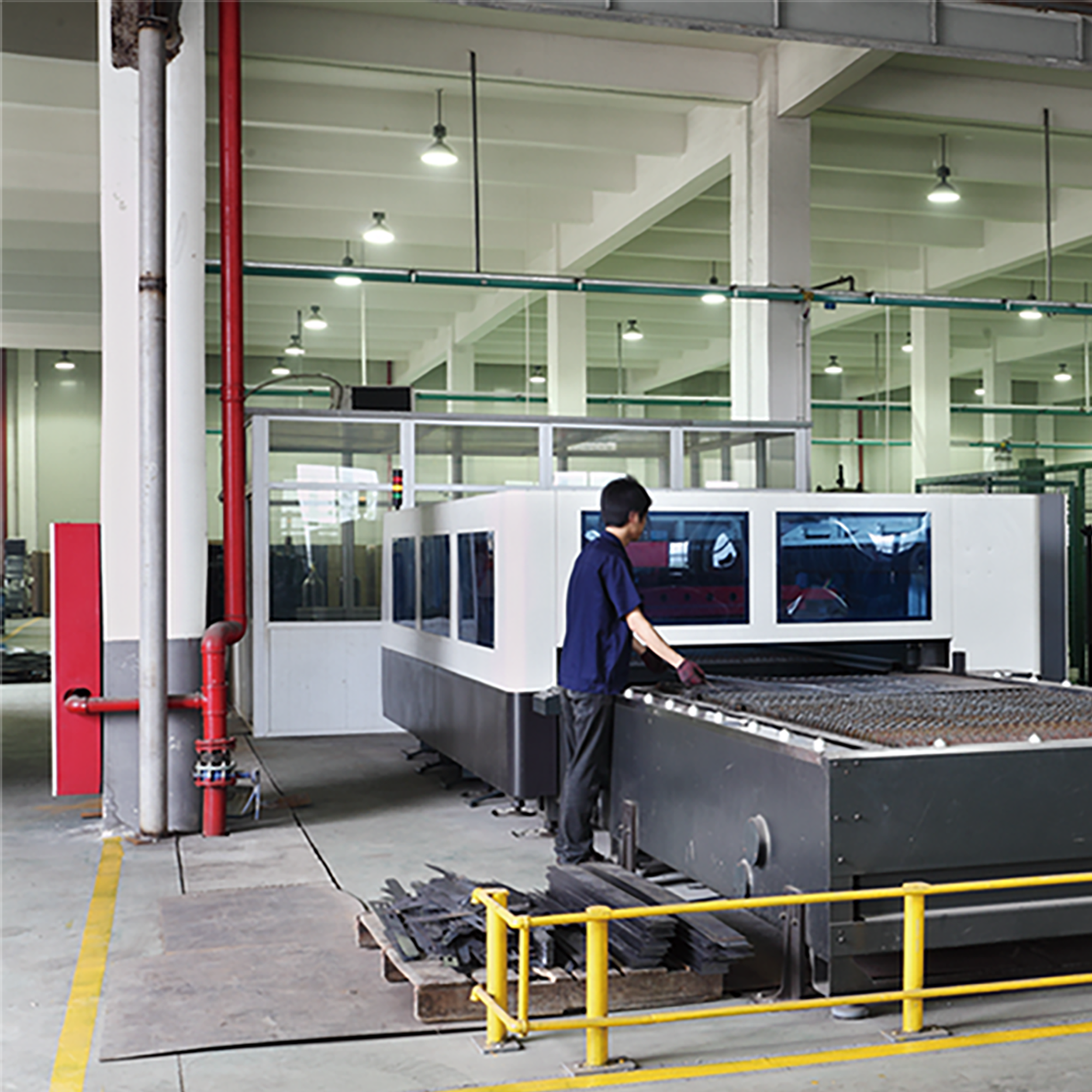
Five screening factors are consistently useful. First, confirm in-house manufacturing depth rather than a pure trading intermediary — Tiger King was established in 2000, operates a 60,000 m² facility with approximately 200 staff and an annual capacity of 240,000 units, and runs laser cutting machines, automatic bending robots, an automatic powder coating line and automatic assembly lines across 5 welding lines, 3 spraying lines and 3 assembly lines. Second, confirm that certifications are issued under the manufacturer's own name and cover the specific models being ordered. Third, request the factory's quality control process — Tiger King runs a full-process system covering incoming, in-line and final inspection, with a lock function test on every safe before shipment. Fourth, confirm project customisation capability for OEM/ODM work. Fifth, confirm the after-sales mechanism for defective goods and spare parts. A factory that welcomes on-site audits and pre-shipment inspections, and that provides complete certification documents and production records for review, is materially easier to verify than one that does not.
Yes. Tiger King provides fully pre-tested safe samples, with every sample inspected in-house before shipment and complete specification documents supplied for buyer verification. Sample inspection should cover physical dimensions and steel plate thickness, appearance and surface finish, lock function across all unlocking methods, mechanical structure and door gap, certification and marking, packaging and accessories, and special functional tests where a certified feature is promised. The current catalogue is available for download, and specific hotel-project configurations can be quoted against room count, room type mix and the three zones described in this guide.
Plan Your Hotel Safe Deployment with Tiger King
Download the current Tiger King catalogue for model-level specifications across the Hotel, Office and Commercial Security Safe lines, or send a project brief covering room count, room types and front-desk layout for a configuration recommendation.
Download 2026 CatalogueVisit TigerKingConclusion
Hotel security safe selection is not a single purchase decision. It is a three-zone deployment where the guest room, the front desk and the back office each place a different demand on the product. The Hotel Security Safe H Series handles in-room storage with temporary passwords and wardrobe-friendly dimensions. The Office Security Safe handles centralised key management with configurable permissions and dedicated key hooks. The Commercial Security Safe handles front-desk cash with a one-way deposit slot, a mechanical lock that does not depend on power, and a format that can be anchored where it stands.
The deployment checks are as important as the model choice. Confirm mounting points, write the override procedure before installation, plan maintenance access around the door and control panel, and run a pre-deployment inspection covering door gaps, lock function, anchors and accessories. Where fire-sensitive documents are involved, pair the appropriate product line with a fire-rated enclosure rather than assuming a general-purpose safe covers that risk. A hotel that plans the three zones separately, and verifies each one against the actual product facts, ends up with fewer guest complaints, cleaner cash handling and a back office that can produce its records when asked.
Have Questions or Need More Details?
Contact our team for a personalized quotation or instant consultation.
Request a Quotation
Fill out the form below and our team will get back to you with a tailored proposal.
WhatsApp Direct Chat
Prefer to chat in real-time? Message us on WhatsApp for instant assistance & quick answers.
- Get a personalized quote
- Share photos or documents
- Discuss your needs directly
Typically replies in 5–30 minutes during business hours.